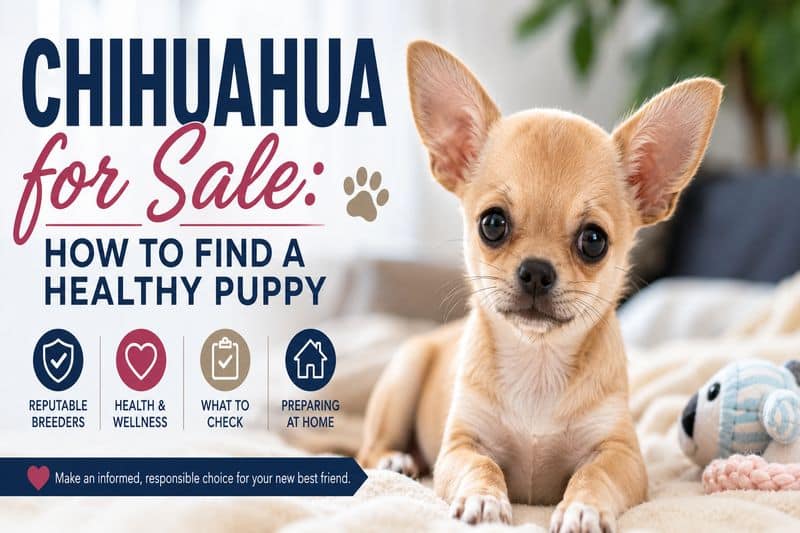
Searching for a Chihuahua for sale can bring up hundreds of listings, but finding a healthy, well-socialized puppy from a responsible source requires more than comparing photos and prices.
Chihuahuas are tiny, alert, confident companion dogs with big personalities. The American Kennel Club standard describes them as compact, graceful, alert dogs with terrier-like confidence, and the breed standard places the ideal adult weight at no more than 6 pounds.
If you are searching for Chihuahua puppies for sale, this guide will help you evaluate breeders, understand pricing, identify health-testing documentation, avoid scams, and consider adoption.
SmartPetCareGuide does not sell or broker puppies. This guide is educational and is designed to help US families make a more informed decision when buying or adopting a Chihuahua.
Chihuahua Puppies for Sale
When searching for Chihuahua puppies for sale, you will generally encounter three main options:
- Responsible hobby or professional breeders
- Chihuahua-specific rescue organizations
- Local animal shelters and humane societies
Each option has advantages and considerations.
A responsible breeder should be willing to explain how puppies are raised, provide veterinary and health-testing information, answer detailed questions, and allow you to learn about the puppy’s parents. The American Kennel Club recommends visiting a breeder’s home or kennel, observing the dogs’ living conditions, and asking about health screening for both the puppy and its parents.
Rescue and shelter adoption can be an excellent alternative if you are not committed to getting a very young puppy. Adult Chihuahuas can sometimes be easier to evaluate because their size, temperament and personality are already more established.
Be especially cautious with listings that focus heavily on phrases such as “teacup Chihuahua,” “micro Chihuahua” or “rare tiny Chihuahua.” These are not separate AKC varieties. The official Chihuahua breed standard does not recognize a “teacup” variety.
When comparing Chihuahua puppies, look beyond appearance. A healthy breeding program, appropriate socialization, transparent records and responsible placement are more important than an unusual coat color or exceptionally small size.
How Much Does a Chihuahua Cost?
The Chihuahua puppy price in the US varies considerably. Current published estimates put reputable-breeder pricing roughly from $800 to $3,500 or more, depending on the breeder, region, lineage, coat type and what veterinary care is included. Some specialist breeders charge considerably more.
Because there is no authoritative nationwide price list, treat online price ranges as budgeting estimates rather than guaranteed market prices.
| Expense | Typical consideration |
|---|---|
| Chihuahua puppy | Roughly $800–$3,500+ depending on source and quality |
| Rescue/shelter adoption | Often substantially less than breeder purchase |
| Initial veterinary care | Exam, vaccines, parasite prevention and other recommended care |
| Supplies | Crate, bed, food, bowls, leash, collar, toys and grooming supplies |
| Training | Puppy classes or private training |
| Preventive care | Routine veterinary visits and parasite prevention |
| Dental care | Particularly important to budget for in small breeds |
| Pet insurance | Optional but worth comparing before health problems develop |
For example, one recent US pet-care source estimates Chihuahua adoption fees around $250–$350, although actual fees vary by organization, location, age and medical needs.
What makes a Chihuahua more expensive?
Several factors can affect the price:
Breeder reputation: A breeder investing substantial time and money into health testing, veterinary care, socialization and responsible placement may charge more.
Health testing: Responsible breeders should be able to document breed-appropriate screening of their breeding dogs.
Pedigree and registration: Established pedigrees and show or performance backgrounds may influence pricing, although registration alone does not prove that a breeder is responsible.
Coat type: Chihuahuas are recognized in smooth and long coat varieties, and demand for particular appearances can influence prices.
Location: Puppy prices and veterinary expenses vary considerably across the US.
Veterinary care: Vaccinations, deworming, examinations, microchipping and other included services can affect the initial price.
Socialization and early care: A breeder who spends significant time raising puppies in an appropriate environment is providing value that may not be obvious from a listing photograph.
A very low price should not automatically mean “good deal.” Equally, a high price does not automatically mean high quality.
Chihuahua for Sale Near Me
Searching for a Chihuahua for sale near me is convenient, but proximity should not be your primary selection criterion.
A breeder two or three hours away who provides transparent health records and allows you to visit may be a much better choice than a seller located 20 minutes away who refuses to show where the puppies are raised.
When evaluating a local breeder, try to:
- Visit the breeder or arrange a legitimate in-person meeting.
- See where the puppies are raised.
- Meet the mother when appropriate.
- Ask to see health-testing documentation.
- Review veterinary and vaccination records.
- Ask how the puppies have been socialized.
- Read the purchase contract before paying.
- Confirm the breeder’s return or rehoming policy.
- Verify the puppy’s identity and records.
- Avoid sending a deposit simply because someone says another buyer is waiting.
The AKC specifically recommends visiting breeders, observing their facilities and meeting at least one parent when possible.
You can also search locally for Chihuahua rescues, municipal shelters and humane societies. If you are open to an adult dog, expanding your search radius can significantly increase your options.
Where Can You Find a Chihuahua for Sale?
Responsible Chihuahua breeders
A reputable breeder should be transparent about their dogs and breeding practices. They should also be interested in whether you are a suitable owner.
The American Kennel Club notes that responsible breeders often ask prospective buyers many questions and may use contracts that include provisions requiring the dog to be returned to the breeder if the owner can no longer keep it.
Chihuahua rescue organizations
Breed-specific rescue groups can be particularly useful if you want a Chihuahua but do not necessarily need a puppy.
You may find puppies, young adults and senior Chihuahuas needing homes.
Animal shelters
Local shelters and humane organizations are another option. Chihuahua mixes are also worth considering if your priority is finding a compatible companion rather than obtaining a particular pedigree.
Recognized breed organizations
The Chihuahua Club of America is the AKC parent club associated with the breed and provides breed-specific information, including health and rescue resources. Its health guidance supports screening breeding dogs for cardiac, patella and eye concerns.
How to Find a Reputable Chihuahua Breeder
Finding reputable Chihuahua breeders requires research.
Start by looking for breeders who are knowledgeable about the breed rather than sellers who simply advertise large numbers of puppies.
1. Ask about health testing
The breeder should be able to explain which tests have been performed on the parents and provide documentation where applicable.
For Chihuahuas, the AKC lists:
- Patella evaluation
- Cardiac examination
- Ophthalmologist evaluation
as recommended health tests from the national breed club. You can review AKC’s recommended Chihuahua health tests to understand which screenings are recommended for responsible Chihuahua breeding programs.
2. Visit the breeding environment
Whenever practical, visit the breeder in person.
Look for puppies that appear clean, alert and appropriately social. The environment should be reasonably clean and the dogs should appear comfortable around the breeder.
3. Meet the parents
Meeting the mother can provide useful information about her temperament and physical condition. Depending on the breeding arrangement, the sire may not live on the premises.
Do not expect a breeder to guarantee that a puppy’s adult personality will exactly match its parents.
4. Ask about socialization
Good breeders begin exposing puppies to appropriate people, household experiences, sounds and handling before they leave.
This is particularly important for Chihuahuas because early socialization and positive training can help them become more comfortable around unfamiliar people and animals.
5. Review the contract
Read the entire contract before making a payment.
Look for:
- Health guarantee
- Buyer responsibilities
- Vaccination information
- Registration details, if applicable
- Spay/neuter requirements, if applicable
- Return-to-breeder provisions
- Rehoming requirements
- What happens if a serious health issue is discovered
6. Evaluate breeder transparency
A reputable breeder should be comfortable discussing both the strengths and potential health concerns of Chihuahuas.
The AKC’s responsible breeder guidance also emphasizes evaluating the breeder’s practices, environment, health information and commitment to the dogs they produce.
Be suspicious of anyone claiming that their puppies are completely free from all genetic or future health problems.
Chihuahua Health Testing to Ask About
Health testing is one of the most important things to investigate before purchasing a Chihuahua.
The Chihuahua Club of America and AKC identify three primary screening areas for the breed:
| Screening | What it evaluates |
|---|---|
| Patella evaluation | Kneecap stability and patellar luxation |
| Cardiac examination | Heart health and detectable cardiac abnormalities |
| Ophthalmologist evaluation | Eye health |
The Chihuahua Club of America explains that its CHIC health-testing protocol includes OFA cardiac, eye and patella examinations. It also notes that patella certification for CHIC requires the dog to be at least one year old, while preliminary patella examinations can occur earlier.
The Chihuahua Club of America’s health-testing guidance provides additional breed-specific information about these screenings and responsible breeding considerations.
The OFA health records database can also help prospective puppy buyers research documented health screening results for potential parents and their relatives.
Health conditions worth discussing
Chihuahuas can be susceptible to various health problems, including patellar issues, dental problems and certain cardiac or eye conditions. This does not mean an individual puppy will develop them.
Ask the breeder:
- What health problems have occurred in the parents’ lines?
- What testing has been performed?
- Can I see the actual certificates?
- Are the parents searchable in the OFA database?
- Has the puppy received a veterinary examination?
- What follow-up care does the contract recommend?
Health testing reduces risk; it does not provide an absolute guarantee of lifelong health.
Red Flags When Looking for a Chihuahua for Sale
Puppy scams frequently exploit buyers who are emotionally attached to an adorable photograph.
Watch for these warning signs:
- The seller refuses video calls or in-person visits.
- Only stock or professionally staged photos are provided.
- The puppy is supposedly available immediately with no questions asked.
- The seller pressures you to pay a deposit immediately.
- Health records cannot be verified.
- The seller refuses to identify the puppy’s parents.
- The seller wants payment through an unusual or difficult-to-reverse method.
- Shipping is the only available way to receive the puppy.
- The price is dramatically below comparable puppies without a credible explanation.
- Multiple breeds are advertised with dozens of puppies constantly available.
- The seller claims “teacup” is an official Chihuahua variety.
- The breeder refuses to provide a written contract.
- You are asked for repeated payments for “insurance,” “special crates,” “airport clearance” or similar unexpected charges.
Be particularly careful when the seller creates urgency: “You have to pay within the next hour or someone else gets her.”
A responsible breeder should be interested in finding the right home rather than simply completing a transaction.
Questions to Ask a Chihuahua Breeder
Before you buy a Chihuahua puppy, save this checklist and ask the breeder:
- How long have you bred Chihuahuas?
- Why did you choose this particular breeding?
- Can I meet the puppy’s mother?
- Where are the puppies raised?
- What health testing was performed on both parents?
- Can I see the OFA or other health records?
- What veterinary care has the puppy received?
- Which vaccines and deworming treatments have been given?
- Has the puppy been microchipped?
- How have you socialized the litter?
- What food is the puppy currently eating?
- What is the puppy’s expected adult size?
- What does your health guarantee cover?
- What happens if I can no longer keep the dog?
- Do you require a written contract?
- At what age do your puppies go home?
- Can I speak with previous puppy owners?
- Will you remain available for questions after I take the puppy home?
Pay attention not only to the answers but also to the breeder’s attitude.
A good breeder should not become defensive because you ask reasonable questions.
What to Check Before Buying a Chihuahua Puppy
Before taking a puppy home, ask to review its veterinary documentation and observe its general condition.
Look for a puppy that appears:
- Alert and appropriately active
- Clean
- Interested in its surroundings
- Comfortable being handled
- Able to walk and move normally
- Appropriately social for its age
You should also review:
- Vaccination records
- Deworming records
- Veterinary examination documentation
- Microchip information, if applicable
- Parent health-testing records
- Registration or pedigree documents, if applicable
- Written contract
- Feeding instructions
- Current food information
Do not attempt to diagnose a puppy yourself based on appearance.
If you are uncertain about the puppy’s condition, consider having your own veterinarian examine the dog as soon as possible after adoption or purchase, according to the terms of your contract.
When Can You Bring a Chihuahua Puppy Home?
A responsible breeder generally should not send a Chihuahua puppy home too young.
The AKC says most puppies are ready to leave between 8 and 10 weeks, while some puppies—particularly small or toy breeds—may benefit from staying with their breeder longer. For additional context, see the AKC’s guidance on when puppies can go home before deciding when a Chihuahua puppy should leave its breeder.
AKC breeder guidance also notes that responsible breeders may keep puppies until 8–12 weeks, giving them additional time to mature and socialize. Toy breeds can sometimes be held longer because of their smaller size and slower development.
For a Chihuahua, do not assume that the earliest possible pickup date is best.
Ask the breeder why they believe the puppy is ready. The puppy should be appropriately weaned, eating reliably, developing normally and prepared for the transition.
Early socialization is also important. Puppies need appropriate exposure to people, sounds, handling and new experiences during their early developmental period.
Chihuahua Adoption vs. Buying From a Breeder
There is no single correct choice for every household.
| Option | Advantages | Considerations |
|---|---|---|
| Responsible breeder | Known parentage, predictable breed characteristics, puppy history | Higher upfront cost and waiting periods |
| Chihuahua rescue | Gives a dog another chance, adult temperament may be easier to assess | History may be incomplete |
| Shelter | Potentially lower adoption cost and many dogs need homes | Breed/background may be uncertain |
| Chihuahua mix | Can offer many desirable companion traits | Adult characteristics can be less predictable |
If your primary goal is companionship, Chihuahua adoption deserves serious consideration.
If you specifically want a responsibly bred purebred Chihuahua puppy with known lineage, a reputable breeder may be the better fit.
The important distinction is not simply “buy versus adopt.” It is whether the particular dog and source are appropriate for your household.
Is a Chihuahua Right for You?
Before searching for a Chihuahua for sale, make sure the breed fits your lifestyle.
Chihuahuas are tiny but should not be mistaken for low-maintenance accessories.
Temperament
They are alert, confident and often deeply attached to their owners. Their small size can hide a surprisingly bold personality.
Exercise
Chihuahuas generally need less exercise than large working breeds, but they still need daily movement, play and mental stimulation.
Grooming
Smooth-coat Chihuahuas generally need relatively little coat maintenance. Long-haired Chihuahuas need more regular brushing to prevent tangles and mats.
Training
Start training early. Positive reinforcement works well, and small dogs still need boundaries, manners and socialization.
Children
Their very small size makes them vulnerable to accidental injury. AKC advises caution with homes containing children, particularly where rough play is likely.
Other pets
Early, controlled socialization can help Chihuahuas become more comfortable with other animals. Their individual temperament still matters.
Apartment living
A Chihuahua can adapt well to apartment living because of its small size and relatively modest exercise needs. However, barking can become a significant issue if it is not managed through training and environmental enrichment.
For a complete overview of temperament, grooming, nutrition, exercise and health considerations, see the SmartPetCareGuide Chihuahua Complete Guide.
Preparing for Your New Chihuahua Puppy
Before your puppy arrives, prepare the home rather than buying everything after the fact.
Essential supplies include:
- Appropriately sized crate
- Comfortable dog bed
- Puppy food
- Food and water bowls
- Collar and identification
- Leash
- Secure harness
- Puppy-safe toys
- Enzymatic cleaner
- Grooming brush appropriate for the coat
- Dog shampoo
- Nail clippers
- Training treats
- Puppy gates or barriers
Because Chihuahuas are exceptionally small, inspect your home for hazards that might not concern owners of larger dogs. Gaps under furniture, stairs, electrical cables and larger pets can present different risks to a tiny puppy.
SmartPetCareGuide resources that can help you prepare include our guides to Best Dog Food, Best Dog Crates, Best Dog Beds, Best Dog Brushes, Best Dog Shampoo, Best Dog Toys, and Best Dog Nail Clippers.
What Does a Chihuahua Cost Each Month?
The purchase price is only the beginning.
A realistic monthly budget can include:
| Category | What to budget for |
|---|---|
| Food | Quality age-appropriate dog food |
| Veterinary care | Routine exams and preventive care |
| Parasite prevention | Flea, tick and other veterinarian-recommended prevention |
| Grooming | Usually modest, especially for smooth coats |
| Dental care | Supplies and professional dental care when recommended |
| Training | Classes or private instruction |
| Insurance | Optional accident/illness coverage |
| Toys and supplies | Replacement toys, bedding, collars and other items |
| Emergency fund | Unexpected veterinary expenses |
Food expenses for a Chihuahua can be relatively modest because of its tiny body size, but veterinary and dental expenses are not automatically tiny.
You should budget for routine examinations, preventive care, vaccinations as recommended by your veterinarian, parasite prevention and unexpected medical expenses.
Pet insurance is another option worth investigating while your dog is young and before pre-existing conditions could affect eligibility or coverage.
The exact monthly cost depends heavily on your location, insurance choices, veterinary clinic, lifestyle and the individual dog’s needs.
Chihuahua for Sale — Frequently Asked Questions
How much does a Chihuahua puppy cost?
A Chihuahua puppy may cost roughly $800 to $3,500 or more in the US, although prices vary significantly by breeder, location, lineage, coat and included veterinary care. Some specialist breeders charge considerably more.
Where can I find a Chihuahua for sale near me?
Look for established Chihuahua breeders, breed-specific rescue organizations, local shelters and recognized breed resources. Do not choose a breeder solely because they are geographically close.
How do I find a reputable Chihuahua breeder?
Look for documented breed-specific health testing, transparent veterinary records, appropriate puppy socialization, a clean environment, willingness to answer questions, a written contract and a clear return policy. AKC recommends visiting breeders and evaluating both the dogs and their living conditions.
Are Chihuahua puppies expensive?
The initial purchase price can vary considerably. However, the bigger financial commitment is long-term ownership, including veterinary care, dental care, food, preventive medications, supplies and potential emergencies.
Is it better to adopt or buy a Chihuahua?
Neither option is universally better. Adoption can be an excellent choice if you are open to an adult dog or Chihuahua mix. A responsible breeder may be appropriate if you specifically want a purebred puppy with known lineage and carefully documented parent health.
What should I ask a Chihuahua breeder?
Ask about parental health testing, veterinary care, socialization, living conditions, temperament, feeding, contracts, health guarantees and what happens if you can no longer keep the dog.
How can I avoid Chihuahua puppy scams?
Never rely solely on photographs. Verify the seller’s identity, request a live video interaction, visit when possible, inspect records, avoid high-pressure payment demands and be cautious about sellers who refuse to show the puppy or its environment.
What health tests should Chihuahua breeders perform?
The AKC and Chihuahua Club of America identify patella, cardiac and ophthalmologist evaluations as key health screenings for Chihuahua breeding dogs.
How old should a Chihuahua puppy be before going home?
Most puppies are ready around 8–10 weeks, but toy breeds such as Chihuahuas may appropriately stay with a breeder longer. AKC breeder guidance notes that responsible breeders may keep puppies until 8–12 weeks.
Ready to Bring Home a Chihuahua?
Finding the right Chihuahua for sale should be a research process, not an impulse purchase.
Before paying a deposit, verify the breeder or rescue organization, investigate health records, understand the puppy’s background, evaluate the living environment and read the contract carefully. For Chihuahuas in particular, ask specifically about patella, cardiac and eye screening in the parents.
Also remember that the cheapest puppy is not necessarily the cheapest dog to own. Responsible breeding, veterinary care, early socialization and appropriate placement all have value.
If you are flexible about age or pedigree, compare breeder puppies with Chihuahua rescue and shelter adoption. If you decide that a puppy from a breeder is right for your family, take your time finding someone who treats breeding as a long-term responsibility rather than simply a sales business.
Most importantly, choose the right Chihuahua for your household, not merely the first Chihuahua available.